
CyberWorld Builders - Software Engineering & Consulting Services
JL

Jay Long

Software Engineer & Founder

Published January 15, 2024

Updated September 23, 2025

Revenant Hollow: Integrating Technology into Location-Based Horror Experiences

Overview

Revenant Hollow is an interactive, location-based entertainment experience primarily focused on the horror genre, targeting seasonal Halloween markets such as haunted houses and scare attractions. It incorporates advanced technologies to enhance theatrical, story-based attractions, blending mixed reality (virtual and augmented reality), automation, robotics, and Internet of Things (IoT) devices. The goal is to create immersive, interactive environments where technology elevates traditional scare props and visitor engagement.

Key Technological Components

Mixed Reality Integration

  • Virtual Reality (VR) and Augmented Reality (AR): Central to the experience, allowing for overlaid digital elements in physical spaces. Early experiments used first-generation devices like Oculus and Vive, with Pokémon GO as a benchmark for consumer AR. Since then, advancements in hardware (e.g., improved Oculus devices) and software ecosystems have revolutionized the field, incorporating AI for more sophisticated interactions.
  • Mobile Device Utilization: Visitors' smartphones become integral to the experience, leveraging built-in features like lights, sound, haptics (vibration), geolocation, and cameras. This extends beyond basic apps to real-time interaction with the environment, unlocking functionalities like personalized scares or location-triggered events.

IoT and Automation

  • Scare Props and Mechanical Elements: Traditional elements like lights, speakers, and servo motors (e.g., repurposed animatronics) are enhanced with IoT connectivity. This allows for synchronized, responsive behaviors in props, such as jump scares triggered by visitor proximity.
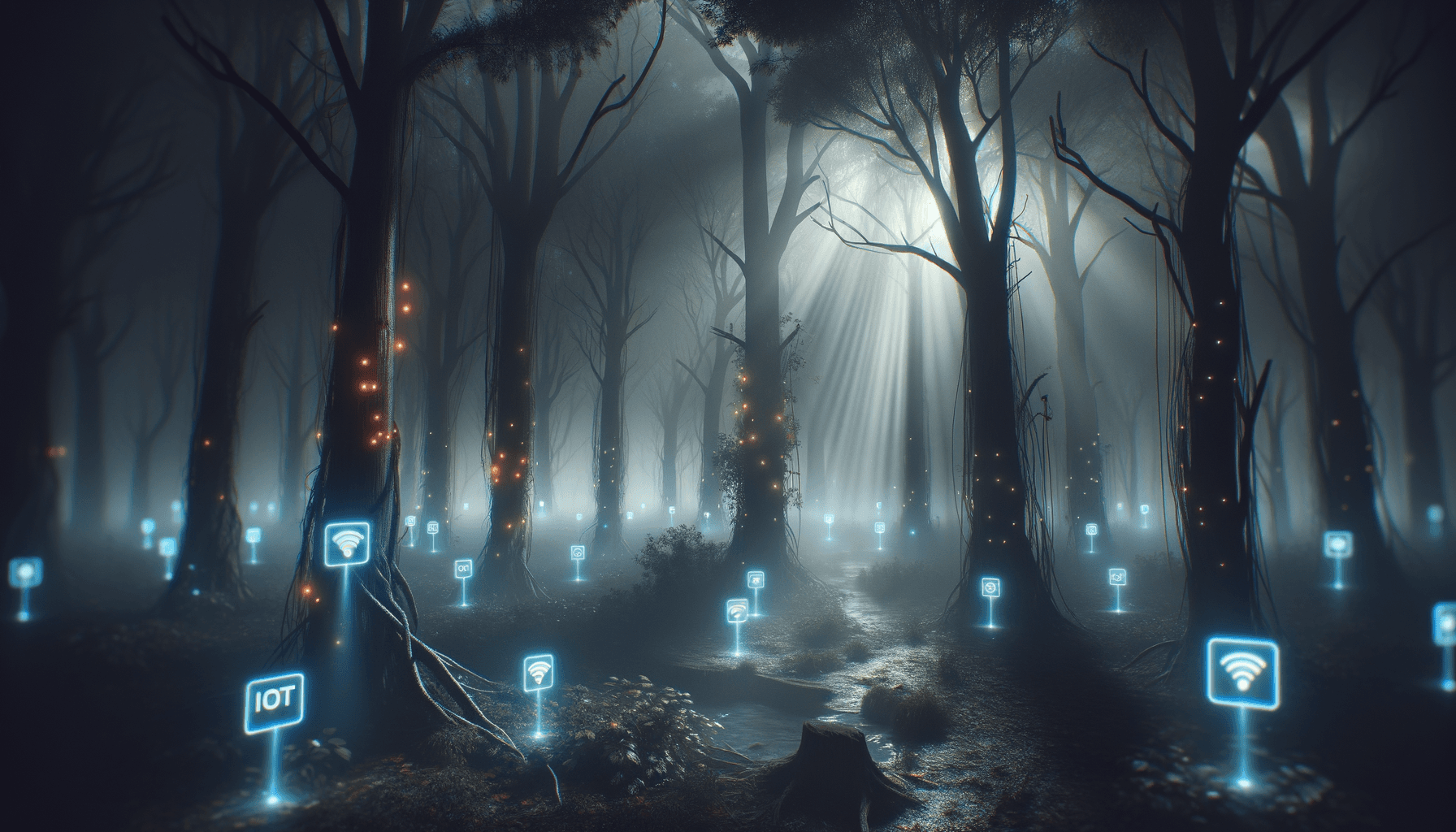
  • Node-Based Infrastructure: Facade walls and structures incorporate standardized "nodes" equipped with devices like Raspberry Pi or Arduino for control, network repeaters, and sensors. Initially planned with wired electricity and data infrastructure (including conduits for power, networking, and speakers), the design has evolved to prioritize batteries, Wi-Fi, and Bluetooth due to modern advancements in battery life and wireless tech. For pneumatics, a centralized compressor handles air distribution to minimize wiring.

Broader Strategic Vision

Revenant Hollow serves as a foundational project for developing expertise in connecting mixed reality with location-based entertainment. It addresses challenges in theatrical attractions, building software and hardware capabilities that can scale to non-seasonal applications. The long-term objective is the Augmented Reality Sports Complex—a permanent facility for interactive, recreational activities that appeal to a wide audience. Key features include:

  • Synchronization across locations for hybrid in-person and remote interactions.
  • Standardized architecture to enable consistent experiences worldwide.
  • Revival of social, location-based entertainment, countering the shift to isolated online gaming by blending physical meetups with digital enhancements.

Development History

Initiated pre-COVID (around 2019), the project involved extensive planning, design, and rudimentary R&D, including lab-based proofs of concept. COVID and rapid tech evolution paused progress, rendering early prototypes obsolete. However, the core designs remain relevant, adapted to current leaps in AI, hardware, and wireless technologies.

Suggested Uses for This Content

This post could be valuable for:

  • Entrepreneurs in Entertainment Tech: Insights into integrating AR/VR and IoT into haunted attractions or similar venues, providing a blueprint for low-barrier seasonal startups on farms or temporary sites.
  • Developers and Engineers: Practical ideas on node-based systems, shifting from wired to wireless infrastructure, and leveraging consumer devices for immersive experiences—useful for prototyping in mixed reality or IoT projects.
  • Event Planners and Theater Professionals: Guidance on blending theatrical elements (e.g., props, wardrobe, acting) with technology to create engaging, story-driven attractions.
  • Investors or Researchers in Location-Based Entertainment: Overview of market evolution from arcades to modern AR complexes, highlighting opportunities in reviving in-person social gaming amid post-COVID recovery.
  • Parents or Educators: Reflections on balancing online and physical activities for youth, inspiring initiatives to encourage community meetups through tech-enhanced recreation.

Validation of Perspective and Authority

As someone with years of hands-on experience in early mixed reality development—dating back to the first-generation Oculus and Vive era—I have witnessed and adapted to pivotal shifts in the field, including the rise of AI-driven enhancements and consumer adoption post-Pokémon GO. My background spans R&D in IoT-integrated entertainment, with direct involvement in designing scalable systems for theatrical attractions. This positions me as an expert in bridging traditional location-based entertainment (e.g., haunted houses, arcades) with cutting-edge tech, informed by observations of generational changes in gaming from the late 1980s/early 1990s arcades to today's online dominance. Industry parallels, such as Microsoft's experimental mixed reality and Magic Leap's high-end applications, align with my designs, while post-COVID trends toward hybrid experiences validate the need for initiatives like the Augmented Reality Sports Complex. My strategic approach—starting with genre-specific, seasonal projects to build toward permanent facilities—mirrors successful tech incubation models, establishing credibility in the immersive entertainment community.

Cleaned Transcript

I want to talk about Revenant Hollow from a technological standpoint because it always means something to me. I don't know what happened in my previous articles on this, because I know I've talked about this a lot. Maybe I just never published anything. But if so, that ends today. So I guess I better start from the beginning. What is Revenant Hollow? No, let me start with almost a tagline, just real short and sweet. What it is, what it does. It's a location-based experience. So it's an interactive location-based entertainment experience, initially focused on the horror genre, the seasonal Halloween market, haunted houses, scare attractions, thriller type stuff. And it's a way to incorporate technology into location-based entertainment experiences, particularly the more theatrical story-based attractions, like a Halloween haunted scare house, jump scare, thriller kind of attraction.

So what all are we doing here? In a high level, just broad, general technological view of what technologies this experience involves: virtual reality, augmented reality are important components; automation, robotics, Internet of Things. So it's a way to connect mixed reality software solutions, and the fact that it's location-based means that we can use IoT devices and anything that's mechanical in scare props—there could be an IoT component there. There will be. In fact, I've actually developed this a lot. I've spent several years, but I've spent a lot of time planning and designing and to some degree doing research and development, although extremely rudimentary proof of concept—more like labs than a true proof of concept. Some of them actually got mature, but it doesn't matter. It's ancient history. What matters is the design and the objective and the plan because it's been so long that everything that I might have developed has gone stale. And every bit of technology that I was developing with has had multiple leapfrog moments. Virtual reality, in particular, has a whole new era, really.

When I was experimenting with virtual and augmented reality, the solutions that I was experimenting with and the technologies, the frameworks, the languages, the libraries, everything in the ecosystem of mixed reality at that time was like early first-generation Oculus, first-generation Vive—that whole era. That's when that was. So when you talk about mixed reality, the only thing people knew about was Pokémon GO, which was probably the most sophisticated, mass-adopted, mainstream pop culture breakthrough product. The flagship of anything that you could consider mixed reality was something like that, at least consumer-facing. There's probably a lot of really high-end business-facing, like Magic Leap, I think is what it was called. And, of course, Microsoft always had experimental mixed reality technologies. But yeah, that's where we were. And so much has happened since then. This was pre-COVID. COVID is to a large degree what knocked me out of the game with what I was working on, and many other things.

But okay, so yeah, there's the mixed reality component. What all advantages have been made in that space? Not just in terms of software. You've got to think what else has changed over the past—we're talking 2019, I think. So you've got to think what all has changed. It's not just the software. It's hardware devices, and it's artificial intelligence. And one notable breakthrough technology is what Oculus has been working on, because this is a consumer-facing platform. So it's really important what devices people know about and adopt. But I don't want to go too far down this. I want to keep it high level. Maybe even talk about some of the history.

So there's a mixed reality component where people's phones become a part of the experience, like become an integral part of the experience, and it's not just like we have a website and we have an app and we have a login where you can buy tickets or something. No, it's like actually a part of the interactive experience. Your phone is—you've got to think, well, let's back up a little, and let's talk about scare props in a haunted attraction, right? So you've got lights, speakers, you've got little servo motors like some Christmas deer motors that are often repurposed for zombies or whatever you can imagine.

Yeah, so that's a good start. That's a good basis. So you've got lights, and you've got sound, and you've got some amount of mechanical devices. And so your phone is all that in your pocket. Your phone has lights. It has sound, and it even has an additional component: haptics with its vibration ability. And then when you think about all the other technologies that you can tap into, if you can just begin to integrate its technological capabilities into experiences, then you suddenly start to realize that it unlocks all kinds of functionality. Geolocation for one. And then you plug that into IoT devices. So where a lot of these experiences fall short is the location-based context gives us a lot of ways we can cheat. We'll also have cameras—that's another important thing. So you get to have all these different parts.

I had designed a specification for facade walls. A part of a good professional scare attraction is to be able to create facade walls. A lot of this stuff is so theatrical. That's one thing that's really exciting about it: if you have any interest in theater, whether that's as an actor or in wardrobe or building props, it's all valuable skills that are interconnected. So just a little side note there. But yeah, so each facade wall—there's similar frameworks behind every facade wall that you'll build. There's an underlying structure, and a part of that underlying structure, you can fit standardized technology. Really, think of it as nodes. And I think that's actually the terminology that I used: nodes. So every so often you'll have a node, and that node would have standard things that you'd expect, like a Raspberry Pi or an Arduino or some kind of network repeater.

One thing that I would certainly change about the initial plan with how I would do things now is I had always envisioned this as having electricity infrastructure, like running wiring to things, and not just electricity infrastructure. I went all in for: we're going to expect that we have conduits, and we're going to expect that we have wiring. We're just going to accept the fact that we're going to have wiring. So we're going to go ahead and run conduit, go ahead and run infrastructure. We can put electrical wires in the conduit, and that takes away the need for batteries because battery life and everything in that whole ecosystem just uses disposable batteries. All the consumer-grade products use disposable batteries. So I naturally was apprehensive about considering batteries at all. So I wanted to just run electricity infrastructure, and then I was like, well, this gives us an additional benefit because if we have electricity infrastructure, then we can run network infrastructure too. So with every conduit, we could run high-voltage and low-voltage wire. We could run power outlet wire and we could run data cabling and maybe even speaker wire, too.

But now I would absolutely call bullshit on that. I would say no, that's dumb, because batteries are so good now that we would plan each node to where it had a battery with the capacity to last whatever's practical—eight hours, something like that—to power all of the electronics. And there would be some cases where, if we had pneumatics, you're going to need to run a compressor. So you've got to be careful about those things, because you need to put your compressor somewhere. That actually makes a lot of sense, because all you would be doing is running air. You wouldn't be running power cables. You would have one big central compressor in a place that was well muffled, and you would just run air from that centralized location.

But yeah, so what I'm getting at is Wi-Fi advancements in battery and Wi-Fi and Bluetooth. It just seems silly now to run electricity infrastructure. That's one good example of how things would be different now.

Okay, so let's talk about how this fits in with a broader scope, a long-term plan that ultimately results in what I call the Augmented Reality Sports Complex. So this is a seasonal thing. It's something you can throw together on a farm. It's something where you can work on advancements in software. The part of the objective strategically of the Revenant Hollow initiative is to develop software and expertise, to cultivate expertise and develop software and hardware that teaches us. Basically, we want to gain capabilities and resources in connecting mixed reality experiences with location-based entertainment, with interactive, theatrical-based entertainment attractions. And solving meaningful problems in that context gives us the ability to apply this to things that are non-seasonal, that are less genre-specific, ultimately establish a permanent facility where there's recreational, interactive recreational activities in location-based recreational activities that appeal to a broader audience—like, not everybody's into horror, and Halloween isn't all year.

The sports complex is a permanent facility that local people can travel to, meet up in person, but also interact with remote users in other parts of the world. And one of the important features and capabilities is syncing up, being able to standardize the architecture of the complex so that people can sync their experiences across locations. And I really feel like this is a huge, that this is a very valuable and important breakthrough to be able to do this, the idea of getting people out of the house again. And this is another reason why COVID derailed this whole initiative.

I think that I've always thought, ever since my kids were babies, watching—I grew up at the tail end of the golden age of arcades, and I grew up in the era of shopping malls, shopping centers, movie theaters, arcades. There were still some pretty awesome arcades. It wasn't the golden age, like the '70s, late '70s, early '80s. I grew up late '80s, early '90s. So I never saw what they call the golden age of arcades. But I went to some pretty badass arcades, and I had a lot of fun for many years. Some of the most fond memories as a young child and a teenager are hanging out at arcades, even if it's just a little offshoot of a shopping mall, going to movie theaters—these kinds of location-based entertainment.

And what happened was I saw this generation essentially consensually plugging into the Matrix, just staying at home. And look, we had consoles too. My generation was more of a balance of location-based experiences, like going out and meeting people in public places, and console gaming from the house. And it wasn't until I was a teenager that online gaming became really crucial. There were always people who would get online and play Doom and stuff, but it wasn't massive. You weren't beginning to see mass adoption online until like Diablo and probably Unreal Tournament was one of the biggest breakthroughs.

And so then I kind of grew up and became an adult and had kids and didn't have as much time for games. And when I saw this whole online world take off, I'm like, nobody's getting out anymore. Everybody's just staying in their basement, connecting to the internet from home. And that's awesome. That's great. I would never say sacrifice that, because I was right there with Unreal Tournament. I was right there with the original Diablo. I saw the magic of online gaming as it emerged as something crucial. And it was magical. I will never deny that. But it took something away that a generation missed out on. And I want this next generation to know how badass it is for it to be normal that you'd hop on your bike or hit your ride or just drop in on some place where other kids meet up and just hang out all day, especially on a Saturday or every afternoon, and there's always snacks and games and movies, and gaming was always a serious component to that.

So that's where the Augmented Reality Sports Complex, the desire, the dream, emerges from: combining next-level networking and the resurgence of location-based entertainment. And what is the nexus? Actually, I should do one on Nexus Protocol Stack. That was interesting. But that's outside the scope of this discussion. Yeah, so what does that look like? That is my objective. And the first phase is Revenant Hollow, because it's seasonal, it's straightforward, it's genre-specific. It's something with enough constraints where we can make meaningful progress and then use the advancements, the research, the development as a stepping stone to move forward with the Augmented Reality Sports Complex initiative. And the standardization of architecture, the standardization of technology, hardware, and the software product ecosystem that will undoubtedly, inexorably, vis-à-vis, concordantly, ergo.

Share this article

Help others discover this content by sharing it on social media